benchmarkfcns.zimmerman
- benchmarkfcns.zimmerman(arg0: Annotated[numpy.typing.NDArray[numpy.float64], '[m, n]', 'flags.c_contiguous']) Annotated[numpy.typing.NDArray[numpy.float64], '[m, 1]']
Computes the value of the Zimmerman benchmark function. SCORES = zimmerman(X) computes the value of the Zimmerman function at point X. zimmerman accepts a matrix of size M-by-2 and returns a vector SCORES of size M-by-1 in which each row contains the function value for the corresponding row of X. Properties:
Global minimum: 0
Location of global minimum: (7, 2)
Number of dimensions: 2
Recommended domain: [0, 100]^2
- Number of local minima: dependent on the penalty factor Z_p, but can have
several “pseudo-minima” along the constraint boundaries.
Number of global minima: 1
Convexity: non-convex
Separability: non-separable
Modality: multimodal
Symmetry: non-symmetric
- Differentiable: Yes (except potentially at the constraint boundaries, where the
penalty term can introduce non-differentiability, but the function is usually well-behaved in practice)
Mathematical Definition
\ zh_1(x, y) = 9 - x - y \ zh_2(x, y) = (x - 3)^2 + (y - 2)^2 - 16 \ zh_3(x, y) = xy - 14 \ zp(t) = 10000 (1 + t)
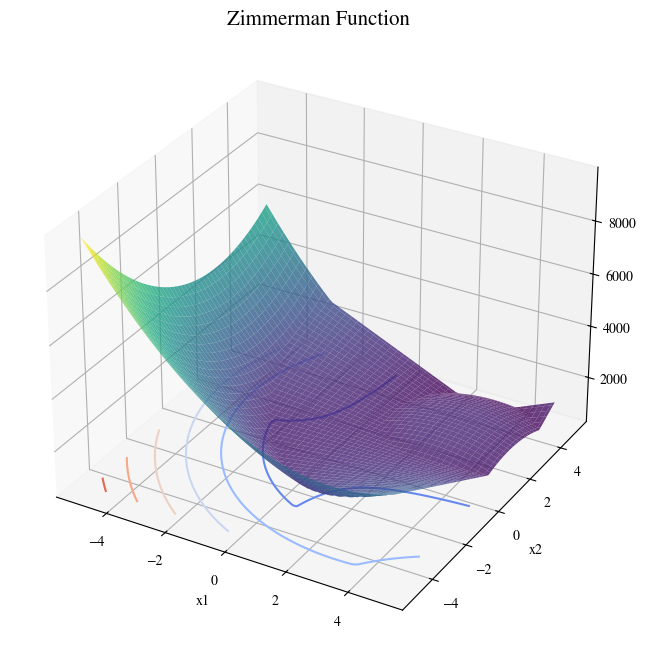
Visualization
|